The iPhone 18 Pro looks promising, but it is not a must-buy
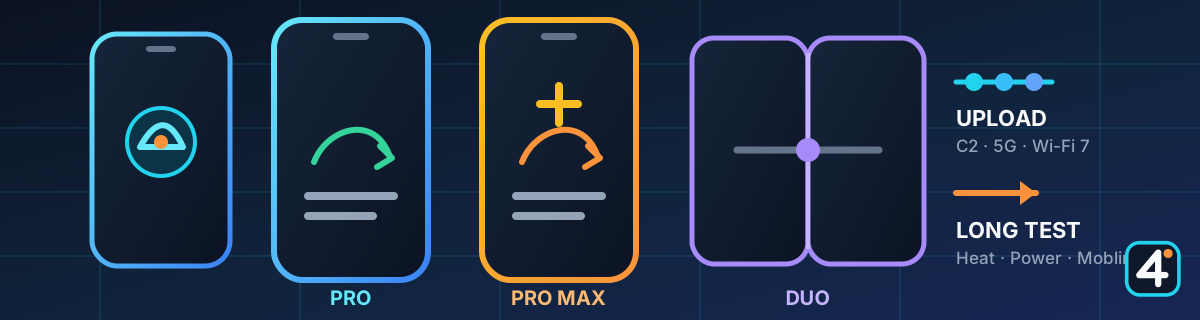
For IRL streamers, the new Pro models hit three important points: a C2 cellular modem built for faster uploads, a much larger vapor chamber for steady performance, and more battery reserve. The iPhone 18 Pro looks like the best-balanced choice for a gimbal and a mobile rig because of its lower weight. The Pro Max offers more runtime but puts more strain on the mount and gimbal. If you already stream stably on an iPhone 16 Pro or 17 Pro, you do not need to switch just because of the model number.
1. What is actually new for streamers?
Apple announced the iPhone 18 Pro and iPhone 18 Pro Max on September 9, 2026. For a livestream, the usual performance records are not what counts. A stable upload over a long stretch is. That is exactly why the new C2 cellular modem, the reworked vapor chamber, the longer battery life, and the faster charging matter more than extra photo effects.
For the C2 modem, Apple cites faster uploads compared with the C1X and 15 percent lower power consumption. That is a manufacturer claim and not yet proof of the same improvement in every German cell. Band allocation, load, plan, and location still decide.
2. iPhone 18 Pro, Pro Max, and Duo compared
| Model | Interesting for IRL streaming | Possible downside | IRL4YOU verdict |
|---|---|---|---|
| iPhone 18 Pro 211 g · 6.3 in | C2 modem, vapor chamber, USB 3 up to 10 Gbps, faster charging | Less battery reserve than the Pro Max | Best-balanced choice for a gimbal and a compact rig |
| iPhone 18 Pro Max 249 g · 6.9 in | Biggest battery reserve of the Pro models, same cellular and USB basis | 38 g heavier; more strain on gimbal and mount | For long sessions, if weight is secondary |
| iPhone Duo 254 g · foldable | C2, Wi-Fi 7, USB 3, and a large screen for monitoring | Heavy, expensive, and still without solid IRL experience; check mounts | Experimental, not the first recommendation for a streaming backpack |
Important: Apple's figures for "streamed video playback" describe playing online video. They are not comparable to the runtime of a running camera livestream, where camera, encoder, display, and cellular all work at the same time.
3. Upload, cooling, and power supply
According to Apple, the iPhone 18 Pro uses a vapor chamber with three times the surface area of the iPhone 17 Pro models. Apple cites up to 40 percent more sustained performance compared with the direct predecessor generation. For Moblin that is relevant in principle, because camera, video encoding, display, and data transfer all stress the device at once. The iPhone 17 Pro already had a vapor chamber, though. On the iPhone 18 Pro the existing concept is made much bigger rather than introduced for the first time.
Official battery figures compared with the iPhone 17 Pro
| Apple test value | iPhone 17 Pro | iPhone 18 Pro | iPhone 17 Pro Max | iPhone 18 Pro Max |
|---|---|---|---|---|
| Video playback | up to 31 hrs | up to 34 hrs +3 hrs / about 10% | up to 37 hrs | up to 43 hrs +6 hrs / about 16% |
| Streamed video playback | up to 28 hrs | up to 31 hrs +3 hrs / about 11% | up to 33 hrs | up to 38 hrs +5 hrs / about 15% |
| 50% wired charge | 20 min with at least 40 W → 15 min with at least 60 W | 20 min with at least 40 W → 15 min with at least 60 W | ||
So the improvement is measurable in Apple's playback tests, and more pronounced on the Pro Max than on the smaller Pro. For streamers that is a positive sign, but not a direct runtime forecast. An active livestream needs camera, encoder, display, and constant upload at the same time and can drain the battery far faster than playing back a video.
Active cooling still makes sense in summer. Apple lists an operating temperature of 0 to 35 °C for these devices. Direct sun, a tight case, high-power charging, and a bright screen can push the temperature up further. And 40 percent more sustained performance does not automatically mean 40 percent longer streaming time. A new cooling system does not replace a real endurance test.
- Test for at least 60 minutes at the resolution and bitrate you plan to use.
- Run cellular, Wi-Fi, Moblink, and external audio hardware together.
- Mount the power supply and cooler the way you will use them on location.
- Watch battery level, case temperature, frame rate, packet loss, and audio sync together.
4. Camera, USB-C, and accessories
The Pro models have a 48 MP main camera with variable aperture, an 18 MP Center Stage front camera, and dual capture with front and rear cameras. Whether and when a streaming app directly supports each new camera feature depends on the app version, though. For Moblin, it is not just the spec sheet that counts but what you can actually select in the app: camera, resolution, frame rate, stabilization, and audio source.
On the iPhone 18 Pro, Pro Max, and Duo, USB-C supports USB 3 at up to 10 Gbps as well as DisplayPort. That leaves headroom for fast data transfer and accessories. For a livestream, you still have to test the USB-C hub, mic receiver, power supply, and any cooling as a complete chain.
5. What only a real IRL test can show
The devices have just been announced and, as of this post, are not yet on general sale. A final verdict would therefore be irresponsible. Before there can be a clear buying recommendation, these points need to be checked with current app versions:
- stable camera capture and encoding over several hours
- how Moblin and Moblink behave under iOS 27
- cellular handovers, reconnecting, and upload with fluctuating reception
- heat buildup while charging and streaming at the same time
- compatibility with gimbals, magnetic coolers, cases, and USB-C accessories
- audio through a USB-C receiver and possible interference while charging in parallel
A single speed test is not enough. What counts is the complete rig in motion, with the same bitrate, the same server, and the same extra devices as in the later stream.
6. Who should upgrade?
An upgrade can make sense if…
- your current iPhone regularly throttles thermally on long streams,
- you need a new main device anyway and want to use it for several years,
- a bigger battery reserve or faster wired charging simplifies your rig,
- you really plan to use USB 3 accessories and the new camera features.
You can keep your current iPhone if…
- Moblin already runs stably and the stream is limited neither by heat nor by performance,
- you stream through an external router and several Moblink devices,
- camera, microphone, cooling, and power supply already work together reliably,
- your cellular plan or the cell itself is currently the real bottleneck.
Our verdict: If you are buying new, look at the iPhone 18 Pro first. The Pro Max is mainly an endurance decision. A working iPhone 16 Pro or 17 Pro does not need to be replaced in a rush for IRL streaming.
7. Why the iPhone Duo is not a clear streaming recommendation for now
With the A20 Pro, C2 modem, Wi-Fi 7, USB 3, and two built-in batteries, the foldable iPhone Duo brings a strong technical basis. Unfolded, the large display has plenty of room for chat, status values, and controls. For a mobile camera rig, though, new practical questions come up: the device weighs 254 g, has an unusual format, and has to be fastened securely in mounts and on gimbals.
The Duo could become interesting for stationary monitoring or as an extra chat device. As the main camera on a gimbal, caution makes sense at first, until suitable mounts and real long-term tests exist.
8. Official sources
This post is our own assessment, written from an IRL streaming point of view. Technical specs and availability come from Apple. A practical IRL4YOU verdict will follow only after solid tests.
IRL4YOU's take
On paper, the iPhone 18 Pro is the most interesting new model for streamers. The mix of lower weight, C2 modem, larger vapor chamber, and USB 3 fits a mobile Moblin rig well. A final recommendation only comes once app compatibility, upload, heat, and power supply work reliably over several real streams.